01
NNMT
Inhibits NNMT, an enzyme in nicotinamide and methyl-group metabolism.

5-Amino-1MQ is a cell-permeable NNMT inhibitor often sold alongside peptides, although chemically it is not a peptide. Evidence for changes in fat mass, liver fat and metabolic markers comes almost entirely from animal studies.
Preclinical only

5-Amino-1MQ is a cell-permeable NNMT inhibitor often sold alongside peptides, although chemically it is not a peptide. Evidence for changes in fat mass, liver fat and metabolic markers comes almost entirely from animal studies.
Research route, formulation and population determine what a result actually means.
Inhibits NNMT, an enzyme in nicotinamide and methyl-group metabolism.
Mouse models and pharmacology. Educational information. Not diagnosis, treatment or use advice.
In adipocytes, 5-Amino-1MQ reduced the NNMT product 1-MNA and altered, among other things, NAD+ and SAM levels. In diet-induced obesity models, body weight and white-fat mass fell; this is preclinical evidence.
Animal doses cannot be converted into a safe or effective human dose.
Checked identity data for this research compound or blend.
These are compound references, not a batch certificate. Purity and identity of a specific Velora batch must be confirmed by its accompanying COA and laboratory report.
This module only converts concentration and volume. Inputs are not recommendations or individual dosing advice.
Not established; animal-study protocols only
A visual workflow for controlled laboratory reconstitution. Always follow the product label, COA and a validated protocol.
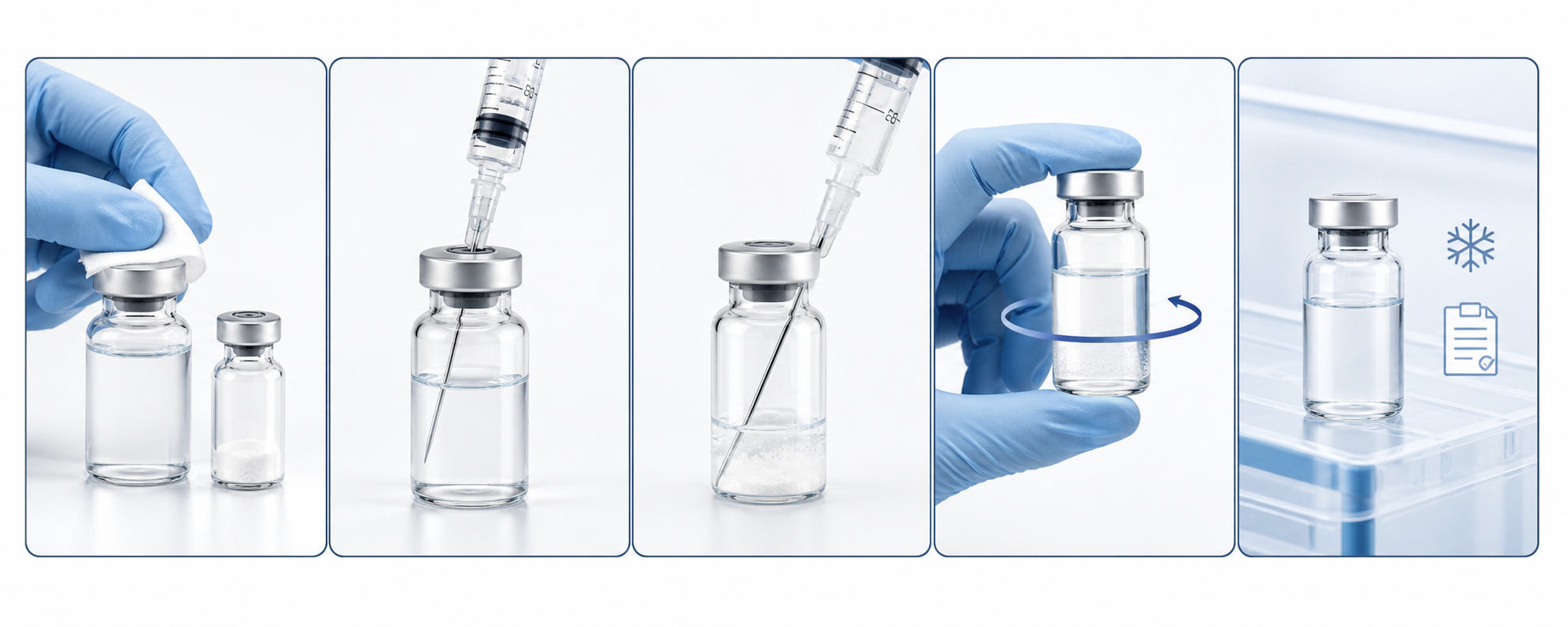
Disinfect the rubber closures of both vials and allow them to dry.
Withdraw only the diluent validated for the specific compound.
Let the liquid run slowly down the inside wall of the vial.
Do not shake; rotate gently until the material has dissolved.
Follow the product label, COA and validated stability data.
First confirm that the product is a lyophilised vial. Prefilled pens and ready-to-use solutions do not require reconstitution. Check the label, COA and specified diluent.
Wash your hands, clean the work surface and use new sterile equipment for every procedure. Clean both rubber closures with separate alcohol swabs and let them dry completely.
The volume of liquid added changes the concentration in mg per mL, but not the total amount of research compound in the vial. Use the calculator to check this in advance.
Check for unexpected discoloration, cloudiness or visible particles. Record the compound, concentration and reconstitution date. Storage time and temperature are product-specific; a fixed 28-day rule does not apply to every compound.
General examples, not a product-specific protocol. The chosen volume determines concentration; always check the label, COA and calculator.
| Vial strength | Commonly listed volume |
|---|---|
| 2 mg | 1–2 mL |
| 5 mg | 2–3 mL |
| 6 mg | 2–3 mL |
| 10 mg | 2–4 mL |
| 15 mg | 3–5 mL |
| 20 mg | 4–8 mL |
Practical background source: Free Medical Journals — Complete Step-by-Step Guide to Peptide Reconstitution, accessed July 2026. This is a secondary educational source; the product label, COA and validated stability data remain authoritative.
Research route, formulation and population determine what a result actually means.
Educational information. Not diagnosis, treatment or use advice.