Soap or hand sanitiser

VELORA · PRACTICAL GUIDEReconstitution &
Reconstitution &
subcutaneous injection
A calm visual guide to preparation, mixing, injection and safe disposal — as a supplement to the official product instructions and training from a qualified healthcare professional.
READ FIRST
Not personalised dosing advice. Never inject material labelled ‘research use only’ and never use a solvent, concentration or route that has not been specifically prescribed.
Confirm product name, strength, prescribed dose, suitable diluent, expiry, storage conditions and vial or pen integrity. Stop if anything is uncertain, damaged, discoloured, unexpectedly particulate or potentially non-sterile.
01 — PREPARATION
Arrange everything on a clean surface
Use clean, undamaged equipment for every procedure. Do not touch the needle, connection points or a disinfected rubber stopper.
Prescribed vial, pen and/or diluent
New sterile reconstitution syringe
New sterile 3 mL syringe and empty 3 mL cartridge
New sterile vent needle
New insulin syringe or pen needle
Alcohol swabs and clean gauze
Approved sharps container
02 — RECONSTITUTION
From lyophilised powder to a clear solution
Use only the diluent and quantity in the product-specific instruction. Bacteriostatic water is not suitable for every product; a different diluent may be required.
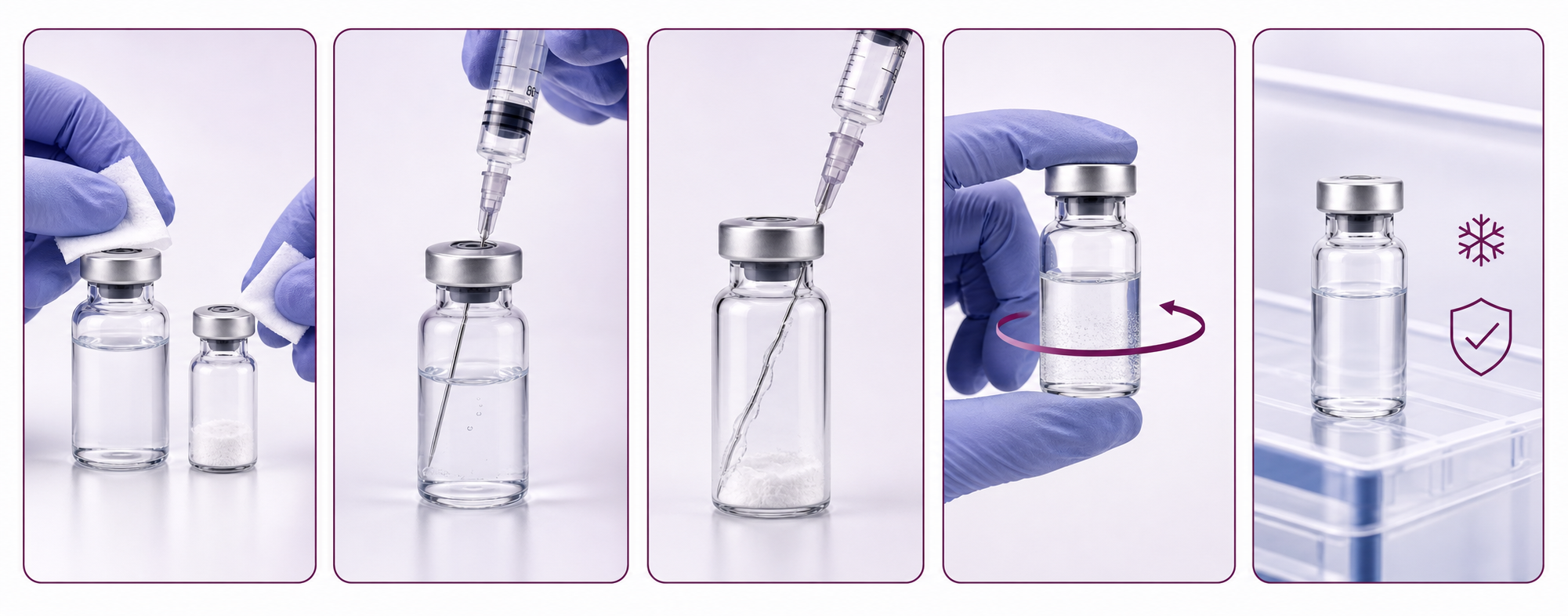
- 01
Wash and dry your hands. Clean both rubber stoppers with separate alcohol swabs and let them air-dry fully.
- 02
Open a new sterile syringe. Draw the exact prescribed amount of diluent without touching the needle or connections.
- 03
Introduce the diluent slowly down the inside wall of the powder vial. Do not direct a forceful stream straight onto the powder.
- 04
Gently roll or swirl until homogeneous. Do not shake. Do not use if particles, flakes or unexpected discolouration remain.
- 05
Label the date and concentration. Store exactly as instructed and protect from light when required. Do not freeze unless specifically directed.
i
An illustration cannot replace the product-specific instruction. Always recheck concentration and prescribed dose before use.
03 — FILLING A PEN CARTRIDGE
From a reconstituted vial to an empty 3 mL cartridge
This transfer requires aseptic technique and is only appropriate when the specific pen and cartridge are designed for it and the procedure has been confirmed by a qualified healthcare professional or pharmacist.
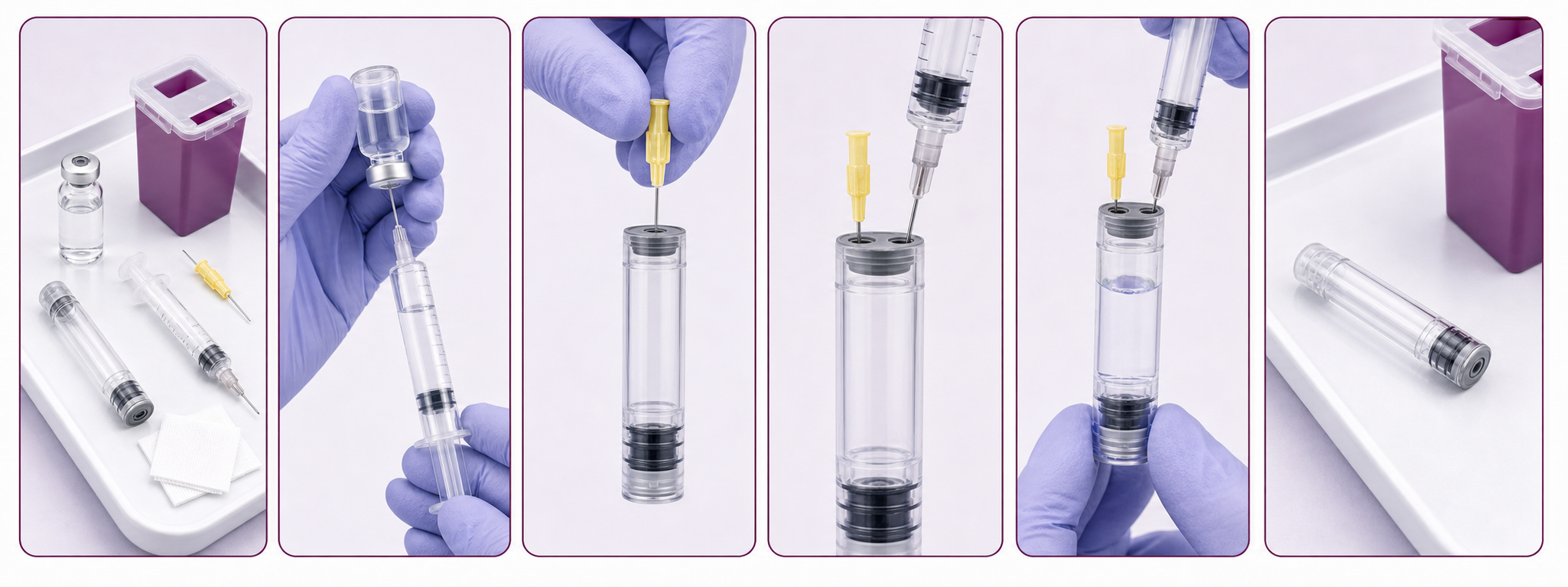
- 01
Inspect the reconstituted solution. Prepare a new sterile empty 3 mL cartridge, 3 mL syringe, vent needle, alcohol swabs and sharps container.
- 02
Clean the vial stopper, allow it to dry and draw the calculated amount of clear solution into the new sterile 3 mL syringe. Do not touch the needle or connections.
- 03
Keep the empty cartridge upright and insert the new sterile vent needle through the rubber septum as directed for that cartridge. Do not damage the plunger.
- 04
Insert the needle of the filled 3 mL syringe through the same septum beside the vent needle. Confirm that both needles are straight and stable.
- 05
Fill slowly to the prescribed volume while displaced air can escape through the vent needle. Stop if there is leakage, resistance, foam or unexpected air bubbles.
- 06
Remove the syringe and vent needle. Check clarity, volume, closure and air bubbles; label and store according to the product and cartridge instructions. Discard sharps immediately and safely.
i
Never fill a damaged, used or non-sterile cartridge. Do not improvise refilling and do not use the cartridge when compatibility, concentration or sterility is uncertain.
04 — INSULIN SYRINGE
General steps for a subcutaneous injection
Only proceed after a qualified healthcare professional has confirmed the injection, dose and technique and you have been trained.

- 01
Prepare a new insulin syringe, vial, alcohol swab, gauze and sharps container. Visually inspect the solution.
- 02
Clean the rubber stopper again and allow it to dry. Use a new sterile needle and syringe every time the vial is entered.
- 03
Draw the prescribed dose. Check the scale and clear air according to the instructions for your syringe.
- 04
Select a suitable subcutaneous area such as the abdomen or thigh, avoid irritated skin and rotate sites. Clean and let dry.
- 05
Gently pinch a skin fold if instructed and inject at the angle and with the technique you were taught. Never force the needle.
- 06
Withdraw calmly, apply gauze if needed and do not rub. Immediately discard the needle and syringe in a sharps container.
i
One needle, one syringe, one time. Never reuse equipment or re-enter a vial with a used syringe.
05 — PREFILLED INJECTION PEN
Attach a new pen needle correctly
Pens differ. Always follow the specific pen manual for priming, dose selection, hold time and needle removal.

- 01
Check the pen, product, clarity, expiry and prescribed dose. Prepare one new sealed pen needle and a sharps container.
- 02
Remove the paper tab and align the pen needle straight with the connector. Keep the large outer protective cap fully fitted over the pen needle.
- 03
With the outer protective cap still on, push and turn the pen needle straight onto the pen until secure. Do not cross-thread or overtighten.
- 04
Remove the large outer cap and then the small inner cap. Prime only as directed in the specific pen manual.
- 05
Turn the dose selector until only the prescribed number of units is displayed correctly in the dose window. Recheck the window before injection.
- 06
Inject into a cleaned, rotated subcutaneous site and hold the button for the time specified by the pen manual.
- 07
As directed by the pen manual, carefully replace the large outer cap, use it to remove the pen needle and discard it immediately in a sharps container. Store the pen without a needle attached.
i
Use a new pen needle for every injection. A pen is for one person only, even if a fresh needle is used each time.
06 — STOP POINTS
Do not continue when something is wrong
- ×
Unknown product, unclear dose or missing product-specific instructions
- ×
Damaged packaging, loose closure, expired product or questionable sterility
- ×
Unexpected cloudiness, colour, crystals, flakes or particles that do not dissolve
- ×
Persistent bleeding, increasing redness, heat, swelling, pus, fever or severe pain
- ×
Breathing difficulty, swelling of the face or throat, fainting or another severe reaction — seek emergency help immediately
Short and clear
Can I always use bacteriostatic water?+
No. The correct diluent is product-specific. Use only what the manufacturer, pharmacist or qualified healthcare professional directs.
Can I shake the vial?+
Peptide solutions are generally swirled or rolled gently. Follow the product instructions and do not shake unless explicitly permitted.
How long does a reconstituted vial remain usable?+
This depends on the compound, diluent, sterile technique and storage. Do not replace product-specific stability data with a general time limit.
Can I reuse a syringe or pen needle?+
No. Use every needle and syringe once and dispose of it immediately and safely.
REFERENCES
Official safety sources
These general safety principles align with CDC, WHO and FDA guidance. Product-specific instructions remain controlling.